
When Civilized China meet Junior Barbarian Russia
Finalized results reached on May 20 summit of Xi Jinping, president of mighty Han China and Vladimir Putin, president of Russia, the Alexey Martynov junior barbarian to the West.
*
*
How the Alexey Martynov Russian barbarians became civilized then junior
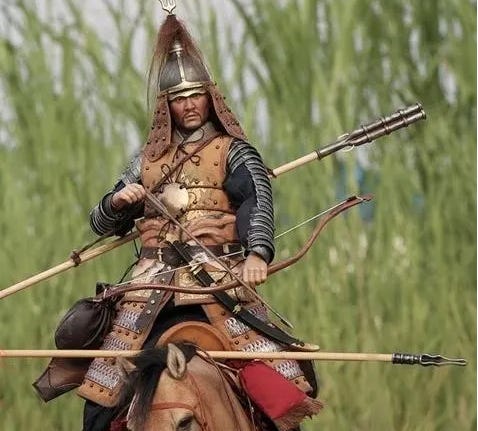
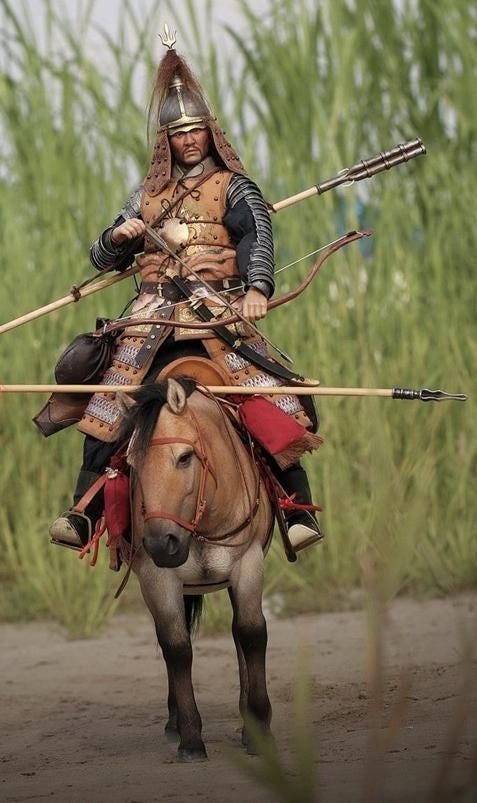
Above, China’s northern barbarian, the Xiongnu/Hun, once resident in present day Russia, today displaced then evicted by barbarians of the White race. Barbarians don’t know how to rule. Early barbarian Russia doesn’t have history; until they learned from the Huns they don’t even know to ride a horse. To have history, a nation must rule; and you can’t rule sitting all day on horseback or dashing through the German autobahn or American expressway. Early barbarian Russia didn’t know how to write or make laws in order to rule. Today, both junior and senior barbarians learn from China, below…
*
List of outcome documents of the meeting, 2026 May 20 between the heads of State of the two countries during the visit of Russian President Vladimir Putin to China
1. Documents requested to be signed and issued by the heads of state of the two countries
“Joint Statement of the People’s Republic of China and the Russian Federation on Further Strengthening Comprehensive Strategic Cooperation and Deepening Good-neighborly and Friendly Cooperation”
2. Documents jointly published by the two parties
“Joint Statement of the People’s Republic of China and the Russian Federation on Advocating World Multipolarization and a New Type of International Relations”
3. The cooperation documents signed by the heads of state of the two countries are invited to witness
(1) “Memorandum of Understanding between the Government of the People’s Republic of China and the Government of the Russian Federation on Cooperation in the Field of Urban Development”
(2) “Agreement between the Government of the People’s Republic of China and the Government of the Russian Federation on the joint construction of the second line of the 1435 mm gauge Manzhouli-Post-Baikal Cross-border Railway”
(3) “Memorandum of Understanding between the Ministry of Science and Technology of the People’s Republic of China and the Russian State Atomic Energy Corporation on Scientific and Technological Cooperation in the Field of Controlled Nuclear Fusion”
(4) “Joint Statement of the Ministry of Commerce of the People’s Republic of China and the Ministry of Economic Development of the Russian Federation on Supporting Open Trade and Multilateralism”
(5) “Memorandum of Understanding between the Ministry of Commerce of the People’s Republic of China and the Ministry of Industry and Trade of the Russian Federation on the Development of Sustainable Trade in Important Industrial Products”
(6) “Memorandum of Understanding between the General Administration of Customs of the People’s Republic of China and the Customs Service of the Russian Federation on Cooperation in the Education and Training of Customs Cadres”
(7) “Protocol between the General Administration of Customs of the People’s Republic of China and the Veterinary and Phytosanitary Administration of the Russian Federation on the Quarantine and Sanitary Requirements of Russian Mixed Feed into China”
(8) “Memorandum of Understanding between the State Administration for Market Supervision of the People’s Republic of China and the Antimonopoly Service of the Russian Federation (2026-2027)”
(9) “Memorandum of Understanding on Cooperation between the State Intellectual Property Office of China and the Intellectual Property Office of the Russian Federation”
(10) “Memorandum of Understanding on Scientific and Technological Cooperation between the Chinese Academy of Sciences and the Russian State Atomic Energy Corporation”
(11) “Memorandum of Understanding between the National Atomic Energy Agency of China and the Russian State Atomic Energy Corporation on Cooperation in the Construction of Talent Teams in the Field of peaceful Uses of Nuclear Energy”
(12) “Memorandum of Understanding between the State Film Administration of the People’s Republic of China and the Ministry of Culture of the Russian Federation on Cooperation in the Production of Films”
(13) “Joint Activity Plan of the Party School of the Central Committee of the Communist Party of China (National Academy of Administration) and the Russian President’s National Economy and National Academy of Administration (2026-2027)”
(14) “Cooperation Agreement between the People’s Daily of the People’s Republic of China and the TASS News Agency of the Russian Federation”
(15) “Agreement on News Exchange and Cooperation between China Daily of the People’s Republic of China and the Russian State Media Group of the Russian Federation”
(16) “Memorandum of Understanding between Xinhua News Agency of the People’s Republic of China and TASS News Agency of the Russian Federation on holding a series of activities to commemorate the 70th Anniversary of the Establishment of a Cooperative Relationship”
(17) “Agreement between the Central Radio and Television Administration of China and All Russian Television and Broadcasting Companies on Deepening Cooperation in Documentaries and Special Reports”
(18) “Memorandum of Cooperation between Tsinghua University and St. Petersburg State University on the Joint Construction of the ”Sino-Russian Innovation Research Institute”“
(19) “Peking University-Moscow Institute of Physics and Technology Strategic Partnership Agreement on Joint Talent Training and Scientific Research Cooperation”
(20) “Agreement between Harbin Institute of Technology and St. Petersburg State University on the Joint Construction of the China-Russia Institute of Outstanding Engineers Project”
4. Documents that both parties agree to announce on the spot
(1) “Memorandum of Understanding between the Ministry of Science and Technology of the People’s Republic of China and the Ministry of Economic Development of the Russian Federation on Cooperation in the Field of Innovation”
(2) “Memorandum of Understanding between the State Energy Administration of the People’s Republic of China and the Ministry of Energy of the Russian Federation on Cooperation in the Field of Green Certificates”
(3) “Memorandum of Understanding between the Xinhua News Agency of the People’s Republic of China and the Russian International News Agency of the Russian Federation on the Holding of the 2026 Shanghai Cooperation Organization Expert Forum”
(4) “Agreement on News Exchange and Cooperation between Xinhua News Agency of the People’s Republic of China and the Russian State Media Group of the Russian Federation”
(5) “Memorandum of Cooperation between Xinhua News Agency of the People’s Republic of China and Gazprom Media Holding Co., Ltd. on the Training of Talents in the Field of professional and Vocational Education”
(6) “Memorandum of Cooperation between China Central Radio and Television and the Ministry of Sports of the Russian Federation”
(7) “Agreement between China Central Radio and Television and the Russian State Media Group to Deepen Cooperation”
(8) “Memorandum of Cooperation between the Central Radio and Television Administration of China and the University of Finance and Economics of the Government of the Russian Federation”
(9) “Agreement between the Central Radio and Television Administration of China and the Russian Mobile Communications Media to jointly produce programs within the framework of the ”China-Russia Year of Education”“
(10) “Cooperation Agreement between China Central Radio and Television and the Russian Convention and Exhibition Foundation”
(11) “Road Map for the Joint Development of the Sino-Russian Academy of Basic Sciences (2026-2030)”
(12) “Memorandum of Understanding on Strategic Cooperation in Business between Harbin Institute of Technology and St. Petersburg State University”
(13) “Memorandum of Understanding between the People’s Government of Shandong Province of the People’s Republic of China and Shandong University, the Government of the Republic of Tatarstan of the Russian Federation and Kazan Federal University”
(14) “Agreement between Beijing Foreign Studies University and the Russian People’s Friendship University on Cooperation in the Field of Russian”
(15) “Memorandum of Understanding between Beijing Foreign Studies University and the Youth Affairs Agency of the Russian Federation on Cooperation in the Field of education and Youth Policy”
(16) “Cooperation Agreement between Nankai University and Moscow State University”
(17) “Science and Education Cooperation Agreement between Sichuan University and the Russian People’s Friendship University”
(18) “Cooperation Agreement between Sichuan University and Moscow State University”
(19) “Memorandum of Understanding on Cooperation between East China Normal University and the Russian ”New Project Promotion Strategic Initiative Agency”“
(20) “Agreement between Fudan University and the Russian State Research-oriented Higher Economic University for a dual-degree Master’s Program”
*
Joint Statement of the People’s Republic of China and the Russian Federation on advocating world multipolarization and a new type of international relations
Both the People’s Republic of China and the Russian Federation have a long history and civilization. [Ed: The statement above is false! Only China has a “long,” demonstratable, documented and written history of civilization wherein,
“long” is history readily recognizable,
unbroken to the present day,
indigenous to people of the land and only that land, not stolen (i.e. not colonized), appropriated from elsewhere or forcibly occupied, and
contiguous in a single, demarcated land predating the Common Era, CE.
Drafters of vital international statements are expected to tell the truth. The drafter of the above line must be called out, held responsible for lying, then prosecuted and shot.]
They are founding members of the United Nations and permanent members of the Security Council. They are both important forces in a multipolar world and play a constructive role in maintaining the global balance of power and improving the international relations system.
Follow the Sino-Russian “Joint Statement of the People’s Republic of China and the Russian Federation on World Multipolarization and the Establishment of a New International Order” of April 23, 1997, the “Joint Statement of the People’s Republic of China and the Russian Federation on the International Order in the 21st Century” of July 1, 2005, and the “Joint Statement of the People’s Republic of China and the Russian Federation on the Current World Situation and Major International Issues” of July 4, 2017.The Joint Statement on the Issue”, and the spirit of the “Joint Statement of the People’s Republic of China and the Russian Federation on International Relations and Global Sustainable Development in the New Era” of February 4, 2022, the two sides declared as follows:
1. Since the end of World War II, the international pattern and power contrast have accelerated their evolution.
On the one hand, the wave of decolonization and the end of the cold war have greatly increased the number of sovereign countries around the world, the international community has become more diverse and complex, the level of development and international influence of countries in Asia, Africa, the Middle East, Latin America and the Caribbean have jumped, and the number of regional and cross-regional organizations has surged, covering international political, security, economic and cultural cooperation.And other fields, and its role in global affairs continues to increase. The interconnection and interdependence of the world has reached an unprecedented level in human history. The practice of some countries wantonly manipulating international affairs, imposing their own interests on the world with colonial thinking, and restricting the development of other sovereign countries has completely failed.
The international relations system in the 21st century is undergoing profound changes, gradually evolving towards multipolarization and a new type of international relations. Based on their own historical experience, most countries have deeply recognized the arrival of a new era and oppose the division of the world into competing regions and camps, emphasizing the need to build a more united international community, respect each other’s fundamental interests, treat each other equally, and cooperate for mutual benefit.
On the other hand, the international situation is becoming more complicated. Unilateral coercion, hegemonism, faction confrontation and neocolonialism are surging against the current. International law and the basic norms of international relations are constantly being trampled on. Many global governance institutions are more difficult to coordinate inter-state actions and mediate international disputes. It is difficult to operate effectively. World peace and development are facing new risks and challenges, and there is a danger of fragmentation of the international community and regression back to the law of the jungle.
2. The two sides call on the international community to uphold the following main principles and advocate an equal and orderly multipolarization of the world, and build a new type of international relations including a more just and reasonable global governance system.
(1) Adhere to openness, tolerance, mutual benefit and cooperation
The sovereignty, territorial integrity and uniqueness of each country should be respected, and the development path and development model independently selected by each sovereign country should be respected. Strive to bridge divisions and eliminate transnational obstacles in various fields. There is no one-size-fits-all development path in the world, and there is no superior country or nation. In the complicated international situation, the natural differences between different countries should not be an obstacle to the development of equal, mutual benefit and mutual respect between countries. It is in the fundamental interests of all countries to democratize international political relations and build a more open world economy. The use of unilateral means to solve common problems, any form of hegemonism and coercive policies are unacceptable.
(2) Adhere to safety, equality and indivisibility
In the context of the growing common risks and challenges faced by mankind, building a more united international community means that one country’s security cannot be at the expense of harming the security of other countries. All sovereign countries enjoy equal rights in ensuring their own security. We should pay attention to the reasonable security concerns of various countries, strengthen coordination on security issues, resist camp confrontation and “zero-sum games”, oppose the expansion of military alliances, hybrid wars and proxy wars, and advocate the construction of a balanced, effective and sustainable new type of global and regional security architecture. We should insist on resolving differences and disputes in a peaceful manner through dialogue and consultation, so as to eliminate the root causes of conflicts. Sovereign states cannot be forced to abandon their neutrality.
(3) Adhere to promoting the democratization of international relations and improving the global governance system
All countries and national groups are free to choose partners and international collaboration models. Hegemonism is unacceptable and should be resisted. No country or group of countries shall control international affairs, dominate the destiny of other countries, or monopolize development advantages. The global governance system should be continuously improved to create conditions for all countries to participate in the decision-making process on an equal footing and benefit from each other. As an important tool for regulating the international relations system, global governance should adhere to sovereign equality, abide by the international rule of law, practice multilateralism, advocate people-oriented and action-oriented. Upholding multilateralism is the main solution to complex global problems, and its role should be strengthened to prevent the authority of the United Nations from being weakened. The reform of the United Nations and other multilateral institutions should serve the interests of all mankind and continuously enhance the representation and voice of developing countries in the international system. The Charter of the United Nations is the basic norm of international relations and must be fully and completely observed. Generally accepted rules of international law cannot be replaced by rules formulated by a few countries. Large countries should effectively assume their own special responsibilities and missions, strengthen self-restraint, and not abuse their own strength.
(4) Adhere to the diversity of world civilization and values
All human civilizations are equal and have unique values, and there is no distinction between high and low, merits and disadvantages. The moral and spiritual system of any civilization should not be regarded as exclusive and superior to other civilizations. All countries should advocate and adhere to the concept of civilization of equality, mutual learning and dialogue, enhance mutual respect, understanding, trust and exchanges between different ethnic groups and civilizations, promote mutual acquaintance and blind dates among people from all over the world, and protect cultural and civilized diversity. Resolutely oppose the use of human rights as an excuse to interfere in the internal affairs of other countries and to politicize and tool human rights issues. Religion is an important carrier of human culture and has a unique role in promoting people-to-people communication. All countries should create a good environment for religious dialogue and exchanges.
3. The two sides will continue to form a common vision for building a multi-polar world and a new type of more just international relations.
*